So if you’re worried about the federal debt — and there are some good reasons not to be..."
He is not writing to inform, explain, or clarify. Facts are of little relevance to Dr. Reich. No, he intends to bolster The Narrative, which is the Party line, the factoids and tidbits disseminated by Central Command so that leftist talking heads and agitat"ors can regurgitate coordinated talking points.
So keep in mind that Dr. Reich has an agenda.
This PhD is either woefully maleducated, or a liar. Or both.
------------------------
What the wealthy and powerful — and Treasury Sec. Scott Bessent — don’t want you to know
Friends,
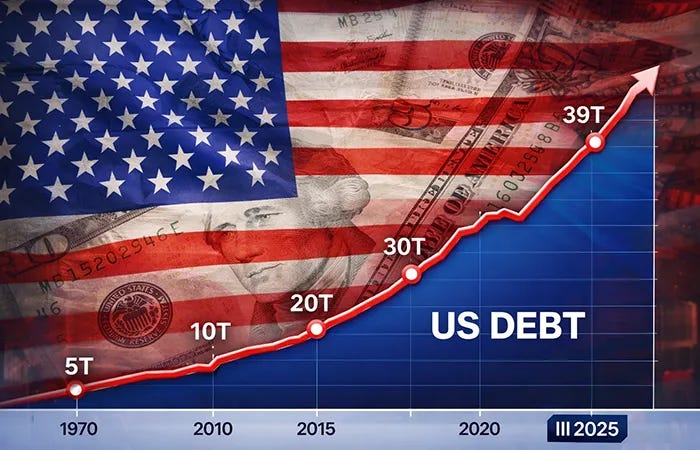
The U.S. national debt has officially surpassed $40 trillion, months earlier than forecasters had expected — because of billions of dollars in lost revenue from Trump’s invalidated tariffs, (Leftists including Dr. Reich opposed the tariffs. Remember?
What the wealthy and powerful — and Treasury Sec. Scott Bessent — don’t want you to know
Friends,
The U.S. national debt has officially surpassed $40 trillion, months earlier than forecasters had expected — because of billions of dollars in lost revenue from Trump’s invalidated tariffs, (Leftists including Dr. Reich opposed the tariffs. Remember?
2 years ago, Dr. Reich himself wrote:
"...this is a regressive tax, taking a higher percentage of the paychecks of the working class and the poor than out of the incomes of the wealthy."
Oh. So Dr. Reich was opposed to the tariffs, that is until he was able to use the tariffs as a bludgeon against Trump. Hmm.)
Trump’s tax cuts (mostly to big corporations and the very wealthy), (It must be a surprise to Dr. Reich that those who pay the most taxes tend to get the biggest tax cuts. But rather than entertain this overused leftist talking point, let's look at the real numbers regarding the big beautiful bill:

Notice how the tax cuts overwhelmingly favor the middle to mid upper class, while the percentage of those in the top 10% or higher get less and less of a tax cut. Those in the top 1% overwhelmingly are bypassed for any substantial tax cut.
Dr. Reich has now deceived us twice.)
and the soaring costs of Trump’s war. (While we are in no way in favor of this war, current estimates put the cost at $41 billion. Yes, a lot of money, but it represents only .6% of the Government budget.
This may be one of the rare times a Leftist complained about government spending.)
Trump’s hair-brained treasury secretary, Scott Bessent, says there’s nothing to worry about because the fiscal trajectory will stabilize. (The fiscal trajectory of what? Tax cuts? The war? The national debt?)
Investors obviously don’t believe him because they’re demanding much higher compensation for buying and holding American bonds. The yield on 30-year U.S. Treasuries hit its highest level in nearly two decades this week, reflecting those growing concerns. (The higher yield of the bonds is a good thing for people who own them, like senior citizens.)
Should you worry? Well, it’s not as if we’re heading into a depression. Passing the $40 trillion threshold doesn’t suddenly cause the world to lose confidence in the dollar. (Oh, the debt is not so bad, hmmm? We wish he would make up his mind.
Should you worry? Well, it’s not as if we’re heading into a depression. Passing the $40 trillion threshold doesn’t suddenly cause the world to lose confidence in the dollar. (Oh, the debt is not so bad, hmmm? We wish he would make up his mind.
And by the way, has Dr. Reich ever heard of Brics, an alliance of nations who have agreed to engage in commerce apart from the US currency standard? Dr. Reich, do you think it speaks to confidence in the US that an organization of nations will do their own spearate thing?)
The problem is that an increasing portion of our nation’s budget — and your tax dollar — is dedicated to paying interest on this growing debt. (This problem began the first time the US ran a deficit. 200 years ago.)
The problem is that an increasing portion of our nation’s budget — and your tax dollar — is dedicated to paying interest on this growing debt. (This problem began the first time the US ran a deficit. 200 years ago.)
Annual net interest payments on the federal debt have surpassed $1 trillion, making servicing the debt one of the largest of all federal budget expenditures. (It has been one of the largest expenditures for decades.)
That’s money we don’t spend on schools, healthcare, roads and bridges, and social safety nets. (Dr. Reich doesn't care about schools, healthcare, or any of it. Because if he did, he wouldn't have complained that the debt isn't a problem. He wouldn't say that deficit spending is desirable:
That’s money we don’t spend on schools, healthcare, roads and bridges, and social safety nets. (Dr. Reich doesn't care about schools, healthcare, or any of it. Because if he did, he wouldn't have complained that the debt isn't a problem. He wouldn't say that deficit spending is desirable:
"A big chunk of the projected debt will finance investments in future growth: infrastructure such as roads, bridges, pipes, and the energy grid. Critical industries such as semiconductors. And the necessary shift from fossil to renewable energies. Without these investments, the U.S. economy would grow far more slowly and the debt would be even larger in proportion to it."
So debt is good. Any amount of debt. We need to spend more money than we take in because the targets of the money are desirable and necessary things. Spending now for "future growth."
Ten years ago and 20 years ago the Left was saying the same thing, that deficit spending funds future growth. Well, we're in that future now. Did yesterday's deficit spending have any discernable effect on today's economic situation? Can Dr. Reich point to any aspect of today's economy and tell us it's better because we deficit spent a decade ago? Indeed, how would we measure that, since we don't have a control group? For all we know, today's economic situation would have been better without deficit spending.
Dr. Reich's economics is based solely on which party is in power.)
We’ll soon be paying more in interest on the federal debt each year than we spend annually on Medicare.
So, who exactly receives these interest payments? This is an issue you hear very little discussion about, because the wealthy and powerful of this country would rather you not know. (And don’t expect Trump suck-up Bessent* to tell you, because he’s too busy denying that economic inequality is worsening.) (Economic inequality has been worsening since WWII, including during Leftists Carter, Clinton, and Obama:
So, who exactly receives these interest payments? This is an issue you hear very little discussion about, because the wealthy and powerful of this country would rather you not know. (And don’t expect Trump suck-up Bessent* to tell you, because he’s too busy denying that economic inequality is worsening.) (Economic inequality has been worsening since WWII, including during Leftists Carter, Clinton, and Obama:

This is another issue that's only a problem based solely on which party is in power.)
Foreign governments and foreign investors hold only about 30 percent of our debt. The rest — roughly 70 percent — is held domestically. That is, we pay the interest to ourselves. (No, not exactly. Dr. Reich will go on to explain who owns the debt, and it's not "Ourselves.")
And who, exactly, is the “ourselves” who receive these interest payments? The Federal Reserve holds part of this debt, state and local governments hold part.
But the biggest chunk — nearly half — is held by mutual funds, pension funds, insurance companies, and banks.
And who owns them? Americans who invest in these funds — and who thereby, directly or indirectly, hold Treasury bills.
And who, exactly are these Americans — the Americans who are directly or indirectly collecting a large amount of the interest we’re paying on the national debt?
People at the top. (After making his list, he immediately claims something else.)
The richest 1 percent of U.S. households hold about 35.6 percent of all financial assets — shares of stock, corporate bonds, and Treasury bills — so it’s safe to assume they hold at least a third of all Treasury bills. (We are getting weary of chasing rabbit trails. Dr. Reich will now proceed to repeat himself verbatim about various claims and bogeymen. We are not interested in further showing his folly, since we have accomplished that above.
Our comments will cease here.)
Here’s where things get really interesting.
Decades ago, wealthy Americans financed the federal government mainly by paying taxes. Their tax rate was far higher than it is today.
In the 1950s, under President Dwight Eisenhower, the richest Americans paid a marginal tax rate of 91 percent. (Tax deductions and tax credits lowered this top effective marginal rate somewhat.)
Today, the tax rate on wealthy Americans is far lower. The richest 400 Americans pay an average effective total tax rate of about 24 percent — including federal, state, local, and corporate taxes. Jeff Bezos — America’s second or third richest person — paid no federal income taxes in 2018. Trump paid no federal taxes for years before he became president.
So now, wealthy Americans finance the federal government mainly by lending it money and collecting interest payments on those loans.
As I said, interest payments on the national debt this year have surpassed $1 trillion, and a big chunk of that is going to wealthy Americans.
Keep following the money.
One of the biggest reasons the federal debt has exploded is that tax cuts — starting with the George W. Bush administration in 2001 and extending through Trump’s 2018 and 2024 tax cuts — have reduced government revenues by $10.6 trillion.
Most of the benefits from those tax cuts are also going to the wealthy.
Since 2000, 65 percent of the benefits from tax cuts have gone to the richest fifth of Americans — 22 percent to the top 1 percent.
So, you see what’s happened?
Decades ago, the wealthiest Americans financed the government by paying higher taxes. Now, the government pays wealthy Americans interest on a swelling debt, caused largely by lower taxes on wealthy Americans.
Which means a growing portion of your taxes and mine is now paying wealthy Americans interest on those loans instead of paying for government services everyone needs.
So, from now on, whenever you hear someone fret about how huge, horrible, and out-of-control the national debt is, explain to them that it’s largely because of tax cuts to the wealthy — who are also the major recipients of interest on that debt.
America’s wealthy have never been wealthier. Scott Bessent* may deny we’re in a K-shaped economy, but he’s dead wrong. If the wealthy paid their fair share of taxes, we wouldn’t have such a huge federal debt. And we wouldn’t be paying them so much interest on that debt.
I noted Monday that Bessent’s claim that we’re NOT in a K-shaped economy — in which inequalities are widening — is pure bullshit, and I provided lots of evidence to back this up. Yesterday he responded with another ad hominem attack on me rather than with facts and analysis (see below). I’m tempted to say he’s an idiot, but that would be an ad hominem attack.
Here’s where things get really interesting.
Decades ago, wealthy Americans financed the federal government mainly by paying taxes. Their tax rate was far higher than it is today.
In the 1950s, under President Dwight Eisenhower, the richest Americans paid a marginal tax rate of 91 percent. (Tax deductions and tax credits lowered this top effective marginal rate somewhat.)
Today, the tax rate on wealthy Americans is far lower. The richest 400 Americans pay an average effective total tax rate of about 24 percent — including federal, state, local, and corporate taxes. Jeff Bezos — America’s second or third richest person — paid no federal income taxes in 2018. Trump paid no federal taxes for years before he became president.
So now, wealthy Americans finance the federal government mainly by lending it money and collecting interest payments on those loans.
As I said, interest payments on the national debt this year have surpassed $1 trillion, and a big chunk of that is going to wealthy Americans.
Keep following the money.
One of the biggest reasons the federal debt has exploded is that tax cuts — starting with the George W. Bush administration in 2001 and extending through Trump’s 2018 and 2024 tax cuts — have reduced government revenues by $10.6 trillion.
Most of the benefits from those tax cuts are also going to the wealthy.
Since 2000, 65 percent of the benefits from tax cuts have gone to the richest fifth of Americans — 22 percent to the top 1 percent.
So, you see what’s happened?
Decades ago, the wealthiest Americans financed the government by paying higher taxes. Now, the government pays wealthy Americans interest on a swelling debt, caused largely by lower taxes on wealthy Americans.
Which means a growing portion of your taxes and mine is now paying wealthy Americans interest on those loans instead of paying for government services everyone needs.
So, from now on, whenever you hear someone fret about how huge, horrible, and out-of-control the national debt is, explain to them that it’s largely because of tax cuts to the wealthy — who are also the major recipients of interest on that debt.
America’s wealthy have never been wealthier. Scott Bessent* may deny we’re in a K-shaped economy, but he’s dead wrong. If the wealthy paid their fair share of taxes, we wouldn’t have such a huge federal debt. And we wouldn’t be paying them so much interest on that debt.
I noted Monday that Bessent’s claim that we’re NOT in a K-shaped economy — in which inequalities are widening — is pure bullshit, and I provided lots of evidence to back this up. Yesterday he responded with another ad hominem attack on me rather than with facts and analysis (see below). I’m tempted to say he’s an idiot, but that would be an ad hominem attack.

No comments:
Post a Comment