Disclaimer: Some postings contain other author's material. All such material is used here for fair use and discussion purposes.

Showing posts with label taxes. Show all posts

Thursday, September 24, 2026

Why focus so much on lowering income taxes? - by Chris Cargill

Found here. Our comments in bold.
----------------------

The author is the typical right-leaning quasi-conservative. We don't wish to be mean, but the the fact is he thinks the Montana tax system can be improved by some tinkering. So, adjusting tax percentages, creating exceptions and deductions and tax shifts are right in the author's wheelhouse.

In other words, more of the same. More rules, exceptions, carve-outs, credits, and surcharges. Page after page of tax law few have read and no one understands.

In actual fact the tax system needs total overhaul. Scrap what's there and create a brand new piece of legislation. We don't care if the state gets less revenue. We don't care if the rich pay their fair share or not. We don't care if Big Business pays zero tax. 

Eliminate the tax system. Make a new one.

We want a one page piece of legislation. Can Montana have a one page tax system? Yup. It's quite simple, and as such is doomed to be rejected by the powerbrokers. 

Before we reveal our proposal, we shall assert that any tax system must embrace these truths:
  • Truth #1: Taxes are a penalty, a disincentive, a confiscation. Taxes dampen economic activity.
  • Truth #2: Taxes are an invasion into the privacy of people. The government should not be privy to the most personal details of a person's life.
  • Truth #3: The sole purpose of taxation is to operate the constitutionally authorized functions of government. It must not be behavior modification.
  • Truth #4: It is wrong to tax something that doesn't engage in economic activity. A house, personal property, vacant land, and vehicles, are in this category. 
  • Truth #5: It is immoral to tax something that has already been taxed. Inherited money, for example, has already been taxed.
So these truths stand in total opposition to the stated goals of the author.

What is this one-page tax system? A flat retail sales tax, levied only on Montana purchases in Montana, constitutionally capped at 4% and constitutionally defined as the only permitted tax. Period. No exceptions, exemptions, or credits. This is the only tax, fee, levy, permit charge, or assessment the government is allowed. Forever.

A retail sales tax ties government revenue to economic activity. If people are doing well they are buying stuff. If people are struggling, they buy less. It doesn't matter if government happens to get less revenue. It needs to live on a budget just like every family does. It needs to be reigned in anyway.
 
In principle, the payment of a sales tax is voluntary. One must buy things to pay it, so the poor won't buy as much, as contrasted with a person who must have lots of money in order to buy lots of things. 

It doesn't matter if people buy out of state. The state must adhere to its own boundaries. It doesn't matter if out of state people come from a no-sales-tax state. When they are in Montana they pay Montana retail sales tax.

If the feds threaten Montana by withholding federal grants, perks, and loans, that doesn't matter either. Montana will learn to be properly budgeted, independent, and economically self-sufficient.

Yes, this is severe. But the problem of big, intrusive government is more severe. 

Reel it in.
---------------------------------

Friday, October 24, 2025

Letter to the editor: By not allowing a local sales tax, we are 'kinda stupid' - by Orville Bach

Found here. Our comments in bold.
-----------------------

This letter writer supports more taxes, which is what a typical Leftist would do. But he goes farther and tells us we are stupid for not wanting more taxes. Specifically, a local option sales tax.
---------------------

Monday, July 21, 2025

Social Security has plenty of reserves, and other myths

Introduction

The Left loves its myths. They will shout them from the rooftops every day, and if someone takes the time to refute them, well, it doesn't matter. The same myths will be shouted even louder the next day.

Here are some Leftists myths about Social Security:
  • Social Security Trust Fund is a stand alone account with trillions of dollars of assets, and therefore does not have anything to do with the finances of the federal government, or national debt or deficit.
  • The assets of the Trust Fund are invested in safe Treasury bonds paying interest to the Fund
  • SS is completely solvent and only needs the income cap to be rescinded so that millionaires pay SS tax on their entire income.
  • SS has an account for each person that accumulates on their behalf
  • SS is like an insurance policy, and
  • SS distributions have a multiplier effect.
None of this is true.

As is typical for the Left, they tell partial truths, omit key details, and twist and dissemble until it is impossible to discern the real situation. So our purpose today is clarify.
-----------------

Monday, May 20, 2024

How “Voodoo” Caused Most of the National Debt

Found here. Our comments in bold.
------------------------

This presentation about the national debt is about the worst we've ever read. The author completely ignores real numbers, relevant facts, and common sense in an effort to explain what he clearly doesn't understand. 

The author's leftist bonafides start showing relatively quickly as he employs all the typical leftist tropes regarding the national debt and various Republicans. 

And, he repeatedly confuses the national debt with the deficit.
----------------------------

Tuesday, June 6, 2023

Letter to the editor: The destabilizing effects of leisure capital - by Steve Kirchoff

Found here. Our comments in bold.
---------------------

This letter to the editor is typical leftist agitprop. The letter writer does what all leftists do: foment envy. It's always about the rich oppressor and the exploited worker.

In this case, the letter writer invents a bogeyman, "leisure capital," and blames it for all the economic issues we face. He has his narrative, and seems to think he doesn't have to explain anything. It sufficient for him to simply make statements as if they're unvarnished truth.

Again, typical for a leftist.

Further, the letter writer wanders from Gallatin County to the Montana Governor and legislature to "Yellowstone clubbers" in Big Sky. Does he even know who his enemy is?

Lastly, it concerns us to note that the letter writer is a political science instructor. Hopefully he's not indicative of the state of political science.
------------------------

Thursday, December 15, 2022

Guest column: Let's support Montana families, not out-of-state millionaires - By Sen. Pat Flowers and Rep. Kim Abbott

Found here. Our comments in bold.
-----------------

This article is replete with leftist bumper-sticker slogans, platitudes, and talking points. It contains no substance, facts, details or concrete information. The writers extensively employ tired worn out leftist tropes (aka agitprop) in an effort to demonize some people and favor other people based on asserted merit.

Most importantly, the Democrats are in the minority in Montana. Substantially so: 
Republicans will hold 68 seats in the House and 34 in the Senate during the 2023 session...
Democrats will occupy 32 seats in the House and 16 seats in the Senate. Therefore, their policies and agenda were rejected, big time. This means they are the ones who need to compromise. They are the ones who need to work with the Republicans. 

They are the ones who need to change.
-------------------

Wednesday, December 3, 2014

If you make $50,000 per year, you pay....

This was posted by a FB friend.
Let's look at the real numbers. Please note that the above post is calculating the allocation of taxes paid for wage earners at a specific level of income, while I am calculating the burden of government for the entire population. Of course, my method makes it even worse for the those who are making these claims.

First claim, that it costs $247.75/yr for defense. Actual budget for defense is $839.9 billion (shown below). With a population of 322.4 million, that works out to about $2605 for every person in the US, per year.

Second claim, $3.98 for FEMA. FEMA's budget request for 2015 is $10.38 billion, which works out to $32 per person, per year. 

Third claim, $22.88 for unemployment insurance. Montana unemployment tax rates are found here on page 16. The average tax rate is 1.92%, which for a $50,000 wage is $960. Federal spending on unemployment insurance was $93 billion in 2012, which equals $288 per person, per year.

Fourth claim, $36.82 for SNAP. Total federal spending for SNAP in 2011 was $78 billion, which is $241 per person, per year.

Fifth claim, $6.96 for welfare. According to the below pie chart, 10% ($390 billion) is spent on welfare, which equals $1209 per person, per year.

Sixth claim, $43.78 for government pensions. From the chart below, that amount is $969.7 billion, which is $3007 per person, per year.

Seventh claim, $235.81 for Medicare. Planned spending for 2015 is $530 billion, which equals
$1645 per person.

For the eighth claim, it's difficult to know what is being measured. I presume it is tax breaks for corporations. We need to note that every tax dollar paid by corporations filter down to the end user, you and I. Taxes are simply another expense included in the price of the products and services you and I purchase. All taxes are paid by people. Nothing is or can be paid by corporations.

One final note. The total planned spending for 2015 is $3.901 trillion. That is $12,100 per person, per year. If the point of the post was to point out how cheap government is and how evil corporations are, well, we can see that this is just not the case.
-----------------------------


GDP: $18,219.4 bln
GO:
$32,178.5 bln


United States Federal
State and Local Government Spending
US CA >
Pop: 322.4 million
-5yr -1yr   Fiscal Year 2015 in $ billion   +1yr +4yr
View: people old default radical census programsaltprog COFOGFedGov.
Xfer
StateLocalTotal
[+] Pensions 969.7 0.0 221.2 47.1 1,238.0
[+] Health Care 1,044.5 -358.1 499.5 146.4 1,332.4
[+] Education 130.7 -69.3 301.0 692.7 1,055.1
[+]
Defense 839.9 0.0 0.7 -0.1 840.6
[+] Welfare 385.8 -113.2 142.8 80.5 495.9
[+] Protection 34.1 -5.1 70.2 165.4 264.6
[+] Transportation 97.8 -67.0 127.2 162.2 320.2
[+] General Government 49.7 -4.1 52.9 71.3 169.7
[+] Other Spending 97.0 -16.3 70.6 326.7 478.1
[+] Interest 251.9 0.0 50.7 66.9 369.4
[+] Balance 0.0 0.0 0.0 0.0 0.0
[+] Total Spending:  Start chart 3,901.0 -633.1 1,536.8 1,759.1 6,563.8
[+] Federal Deficit 563.6 0.0 0.0 0.0 563.6
[+] Gross Public Debt 18,713.5 0.0 1,227.7 1,956.2 21,897.3

Monday, October 20, 2014

How America Punishes People for Being Poor - by Rebecca Vallas

Reproduced here for fair use and discussion purposes. My comments in bold.
------------------------------------

This post first appeared at TalkPoverty.org.

Before we even get started, we need to discuss the headline. America does NOT punish people for anything, let alone for being poor. This is absurd on its face, as if America is an entity with a singular consciousnesses, setting out to purposely trip up poor people. Instead, America is a country, with no emotions, thoughts, or sentience. It is a geographic region organized by political and cultural features. It does not think, feel, hate, or smile.

In fact, America is a unique political experiment in self-governance, created on the principles of liberty and self-determination in the context of Christian morality. If ever there was a place where people of every status and walk of life could work hard and make something of themselves, America is it. 

It is totally offensive for the author to assert that America punishes the poor.
-------------

This past weekend, I was part of a panel discussion on MSNBC’s Melissa Harris Perry with New York Times reporter Michael Corkery, whose reporting on the rise in subprime auto loans is as horrifying as it is important.

In what seems a reprisal of the predatory practices that led up to the subprime mortgage crisis, low-income individuals are being sold auto loans at twice the actual value of the car, with interest rates as high as 29 percent. They can end up with monthly payments of $500 — more than most of the borrowers spend on food in a month, and certainly more than most can realistically afford. Many dealers appear in essence to be setting up low-income borrowers to fail. (We have never understood this assertion that banks want people to fail. Why? What possible good is it for the bank to not collect peoples' installments and thus ending up repossessing the car? The bank loses money!

Also, note how innocent, and apparently stupid, people are being taken advantage of by eeevil salespeople and banks. It's as if poor people are being rounded up door-to-door by dealerships and being forced to buy cars. 

Rather than people being responsible for their own choices, even their bad ones, in typical Leftist fashion someone else is always to blame. And because people need to be protected from themselves, in steps government to rescue them from their own consequences.) 


Tuesday, October 7, 2014

Top 10 Solutions to Cut Poverty and Grow the Middle Class - by Rebecca Vallas and Melissa Boteach

Reproduced here for fair use and discussion purposes. My comments in bold.
----------------------------------------

Here we have another economically clueless article purporting to solve poverty. Read on:
----------------------------------------

This post first appeared at TalkPoverty.

Last month, the US Census Bureau released its annual figures on income, poverty and health insurance. It revealed that four years into the economic recovery, economic insecurity remains widespread, and low — and middle — income workers have seen no significant wage growth over the past decade. (This is why I used the word "clueless." If we are really in a recovery, how is it that the poor and middle class haven't recovered? Definitionally, in order to have a recovery, people need to be recovering, don't they?)

With the poverty rate at an unacceptable 14.5 percent and economic inequality stuck at historically high levels, one might assume that chronic economic insecurity and an off-kilter economy are the “new normal” — that nothing can be done to fix it. (More evidence there is no recovery.)

But there is nothing “normal” or inevitable about more than 45 million Americans living in poverty. It is the direct result of policy choices. With different policy choices, we will see a more equitable economy — it’s as simple as that. (So here is the identified problem, wrong policy choices. In other words, improving the economy, and therefore, the plight of the poor, is centered on what policies government implements. Government action is the only consideration.)

Here are 10 steps Congress can take to cut poverty, boost economic security and expand the middle class. (Ok, so government action is required. You might asssume that these 10 government actions required will be new ideas, things that have not yet been tried. You would be wrong.)

1) Create jobs.

The best pathway out of poverty is a well-paying job. To get back to prerecession employment levels, we (The ubiquitous "we,: which is never "you and I." "We" is government.) 

must create 5.6 million new jobs. To kick-start job growth now, the federal government (See? "We" is government.) 

should invest (Which means, "spend taxpayer money on.") 

in our infrastructure by rebuilding our bridges, railways, roads, ports, schools and libraries, neighborhood parks and abandoned housing; expanding broadband; develop renewable energy sources; and make other commonsense investments that create jobs and boost our national economy. (This is exactly what the stimuli were supposed to fund, remember? Shovel-ready jobs? crumbling infrastructure? This recommendation is exactly what all those billions of dollars were spent on, and yet the number one recommendation is to simply do it again. Maybe this brand new approach will work this time, hmmm?) 

Monday, September 29, 2014

Corporation are not people - letter by Alanna K. Brown

Reproduced here for fair use and discussion purposes. My comments in bold.
---------------------------------

What always strikes me about the Left when they talk about issues like economics is how incredibly colorblind they are. They are content to regurgitate talking points they read on Leftist websites, despite what must be a painful cognitive dissonance. Read on:
-------------------------------
What is so striking about our current political atmosphere is the utter denial by True Believers of the failure of the Voodoo economics of the Conservative Movement of the last 35 years. (Let's note for the record that Reagan left office 25 years ago, and we have had both Republicans and Democrats as president since then. "Voodoo economics," aka "trickledown," has not been in operation since then, if it ever really was. 

But more importantly, with the exception of 1995-1998 and 2001-2007, Democrats have been in control of Congress, and frequently with a Democrat president. It is Congress that has sole constitutional authority to appropriate and spend taxpayer dollars. So let's affix blame were it belongs. Leftist fiscal policies have continued unabated for decades, with only mild mitigation for brief periods. The big spenders, mostly Democrat, but with a number of complicit RINOs, have led this country to its financial devastation.)

Friday, November 22, 2013

Social Security invests in the American people - letter by Alan McCormick

This is the latest in a long string of missives from various people, which began with an editorial written by Joe Balyeat, a local CPA. In it he rightly described Social Security as an unfunded liability, which precipitated a hysterical howl of indignation.

Julie Quenemoen was one such person, She wrote a response to Mr. Balyeat, which can be found at the same link along with my commentary. I distilled that commentary into a letter to the editor, found below. A response was printed in today's Chronicle, and also reproduced below. My comments in bold.

You may need to go back to the original link and read it first in order to understand the exchange.
-------------------------------------
My letter to the editor:

One might hope that Julie Quenemoen would think twice before debating economics with a CPA. It wouldn't be so bad if she entered the fray with something more than talking points, but no such luck.

She asserts that Social Security is funded. Sorry, it isn’t. It appears that she really believes that these budgetary and financing tricks are legitimate.

Permit me to explain. The Social Security Trust Fund is the receptacle for SS revenues. The government makes payment for all benefits, and the balance represents the surplus.

That surplus is then used to purchase special Treasury Bonds that only the Treasury can redeem, and only the Trust Fund can purchase. Bonds are debt instruments, IOUs. They must be paid back, plus interest.

Therefore, there is no money in the Trust Fund.

Once the bonds are issued, the money is added to the General Fund and spent. Yes, SS is not part of the budget, but the obligation to pay back the bonds is, sourced from the General Fund.

Further, she has no right to "her" funds. In Fleming v. Nestor (1960), the Supreme Court held that that there is no right to benefits because Congress has the power to decrease, discontinue, or increase benefits at will.

SS is nothing more than a tax with a promised future benefit. Her money is gone; it paid for someone else’s retirement.

If only Republicans wanted to use SS to reduce the national debt. If only. The debt is higher because of what Congress is doing and has been doing for decades. All that money is long gone, but the bonds are still there, and our grandchildren will pay for them.

So, Ms. Quenemoen, SS has indeed added many dimes to the debt. As far as “hands off our Social Security,” well, that train has left the station.
----------------------------------
Alan McCormick's response:

Social Security is a trust we have with our government, one of many such trusts. It’s hard to understand why insurance agent Rich negates the importance  and viability of insurance. (I made no comment about the importance and viability of insurance.) 

It’s built on contract and trust, just like our Social Security system. (No, the SS system, as I described, is built on accounting tricks. There is no contract for SS, which was the point of me citing Flemming Vs. Nestor. All Mr. McCormick offers is a summary contradiction with no facts, data, or logic.) 

We don’t abandon our car insurance if we don’t have an accident. We don’t claim our homeowner’s insurance is broken and needs to be dismantled when we don’t cash in on damage. (This particular argument mystifies me. Usually when people offer a metaphor, it illustrates some aspect of the debate by offering an enlightening comparison. However, I claimed that my "homeowner's insurance is broken" because there is no real money in reserves to pay claims, not that I haven't had a claim.) 

Why do we pick away at Social Security and claim it won’t be there for our kids and grandkids when they will need it, too? (Why would we pick away at a system that has no money in it and is functionally bankrupt? That is the question that puzzles Mr. McCormick? This is the point, sir. The system is broken, and it won't be there for our kids and grandkids!) 

A whole generation is graduating into jobs with lower wages in a difficult labor market. We should be making Social Security better, and we can do this. (If only Congress was interested in making it better, but no such luck.) 

America is a can do nation! We should allow survivor benefits for students through college. (Oh, that'll help improve it. He wants people to be able to suck even more benefits out of it!) 

Currently, they end at age 18.

I get the sense that some would like to grab our $2.7 trillion trust fund to write down debt, but that wouldn’t help everyday people, nor the economy. (Mr. McCormick glosses right over my direct statement: "If only Republicans wanted to use SS to reduce the national debt." Did he not read this? Or does he intend to persist in his template without regard to what someone already pointed out?) 

Let’s use our money wisely and invest it in people. That’s what Social Security does. (*Sigh* My letter pointed out that there is no money in the Trust Fund. It's becoming clear to me that either Mr. McCormick did not read the letter, or he is intentionally ignoring what I wrote. I know I've pointed this out before, but this is the way the Left thinks. Today is a new day. Nothing has happened before. Every crisis is new, so we must do something. Every refutation offered to them never happened. Every failure is because we didn't do anything before. Arrrgh!)

It pays out small amounts of money to beneficiaries each month, like microfinancing for retirees, disabled people and survivors. The average payment to Montanans in 2012 was $1,088/mo. And what do you think these people do? One-third of seniors rely solely on Social Security to pay for housing, heat and food. Another third of seniors count on SS for half or more of their income; they can occasionally buy a gift for the grandkids, or go visit them. Only that last one-third of seniors is not deeply dependent on this monthly check. (Hmm. 1/3 of current recipients do not need it? Didn't he just say our kids and grandkids will need if? So, do people need it or not? What exactly is Mr. McCormick trying to say?)

Let’s help our Social Security system last another 78 years. Let’s make it stronger! (Exactly the point of my letter. The SS system is a shell game, a ponzi scheme which will come crashing down. Since I did not advocate ending SS in my letter, it should be clear to Mr. McCormick that I was simply pointing out a weakness that must be addressed. 

Once again we find to our dismay a Leftist who is unable to comprehend an argument and offer an on-topic, coherent, substantial rebuttal. Do you see anything in Mr. McCormick's letter that even addresses what I wrote? Me neither.)

Alan McCormick

Manhattan

Friday, May 17, 2013

It’s time to end tax-exempt status - Lane Filler, Newsday - my commentary

Our comments in bold.
--------------
(This author is mostly right, but mostly for the wrong reasons. I'll explain.)

You are a financial supporter of the Westboro Baptist Church. You know, that posse of full-blown whackdoodles from Kansas that descends on our nation’s most tragic moments, particularly military funerals, waving signs that say “Thank God for dead soldiers.” (Notice how  the author begins with an extreme example, which sets the reader up for future agreement based on a distaste for the extreme example.)

You don’t (please say you don’t) support Westboro by sending cash for their placard ’n’ magic marker budget. What you do pay, infinitesimally, is that church’s taxes, because it, like all houses of worship and so many other institutions, is exempt. You also pay the taxes of its contributors, because the money those folks fork over is tax-deductible. (This is incorrect. Tax-exempt organizations do not deprive the government of tax revenue. Legislators choose how tax law will be written, and carve out exceptions, benefits, and surcharges based on the societal outcomes they're trying to achieve. This is a conscious choice by government. No one is being coerced.

But more to the point, all money is privately possessed before it is taxed by government. Government is not entitled to tax anything and everything, simply because it exists. Therefore, its "failure" to tax something does not mean those who are being taxed have had a tax burden transferred to them.

Unless the author is willing to concede that a well-to-do person who pays a 28% tax rate is being burdened by someone else's 15% tax rate.)

Why is this notable this week? Because the Internal Revenue Service just got caught trying to crash the tea party, punk the patriots and deny conservative groups their 501(C)4 status. Such status exempts groups’ income from taxes. It also allows “nonprofits” to do political activism without disclosing donors, as long as the organizations also promote social welfare. (What is "social welfare?" The IRS uses this term.  It suggests that a tax-exempt organization is legitimate so long as its performing a role that government would do ordinarily.  For the second time in two paragraphs, the author makes an observation from a governo-centric perspective, as if everything and everyone revolved around what government does and doesn't do.)

To a politico, the distinction between “promoting social welfare” and “promoting the ideas and candidates that we believe will improve stuff ” is a line about an atom wide. But that’s an outrage for another day. (It's interesting that the Constitution uses the phrase "promote the general welfare" in its preamble, and the phrase "provide for the common defence and general welfare of the the United States" in the context of 16 powers [section 8]. I suspect that the IRS phrase sounds enough like the Constitution to lend it legitimacy.)

The IRS admits it’s been obstructing and scrutinizing right-leaning applicants for 501(C)4 status. This deployment of the IRS — exclusively against a political movement that opposes President Barack Obama like kids oppose calves liver cupcakes — is seriously nefarious. We should fire everyone involved and highlight their sins on a televised reality show called “So You Think You Can Screw Over Conservatives!”

After that, let’s change the tax code so Americans don’t have to fund movements and religions they don’t agree with. (How about, let's eliminate the tax code, repeal the 16th amendment, and defund the IRS so that they don't have any power? The problem is not the tax exempt status, the problem is the excessive power of the IRS!

Ironically, it is government that removes choices. It takes your money and spends it where its priorities are. You cannot choose. However, charities are voluntary.)

No institution, organization or individual should be exempt from taxes, nor should any donations be tax-deductible. (Agreed. Unions, operas, and environmental organizations included. No organization should be singled out for preferential treatment. The constitution forbids congress from making "any law," including favorable ones, regarding the establishment or free exercise of religion. Congress needs to get out of the faith and values business. In fact, it needs to stop meddling with peoples' lives at all levels.)

Nonprofits, hospitals, colleges, houses of worship and charities are sometimes the richest institutions on the block. (Untrue and irrelevant.) 

Yet they generally don’t help pay to sweep that block, or extinguish it if it catches fire, or to fight off another nation’s army or fund school districts. (Sure, and they don't have soup kitchens, clothing drives, volunteer at schools, fund hospitals, build houses for people, or send teams to help when hurricanes hit, either. Yup, that money just disappears down a rat hole, doesn't it?) 

And when their contributors throw them $100 or $1 million, these folks deduct those contributions off their tax liability, too.

Many tax-exempt institutions and organizations do wonderful things. When you identify one, support it with your cash. (Wait, I thought they don't help sweep that block or extinguish if it catches fire... etc.? I thought they were the richest institutions on the block? I thought they weren't paying their fair share?) 

Why, though, should that entitle you to pay less into federal or state coffers, and thus force everyone else, who may hate the college, church or charity you’re contributing to, to pay more? (Hmm. The author apparently doesn't understand the nature of charities. Charities meet needs, and they're very effective and cost efficient. People like helping, and having a choice on where their hard-earned dollars go, as opposed to government extracting it and spending it as it decides, regardless of your preferences. 

See, government does exactly what the author complains charities are doing. People who pay taxes have no voice on where that money goes. And a lot of it goes to supporting values that many find abhorrent. Whether it be illegal invasions of other countries, Planned Parenthood, Piss Christ, or a million other government initiatives, that money it spends was first extracted, with or without permission, from the pockets of private citizens. And the author complains about charities being subsidized by unwilling taxpayers?)

You can argue that a soup kitchen or other charity does work governments can’t afford to handle, thus saving taxpayers money, but it’s a circular argument. The government is broke in the first place because of all the tax exemptions. (At $2.8 trillion in revenue per year, the government is hardly broke. It is broke because it can't control spending. Increasing revenue always results in even more spending. The problem is spending, not revenue.)

What’s more, when a politician wants to fund the Department of Soup For All, I can vote for or against that person based on whether I agree. (A powerless choice, since the person may or may not get elected anyway in contravention of the author's "choice." And even if the author's vote succeeds in obtaining the choice he wants, there is the matter of all the other elected representatives, who may go in a way in opposition to the author's desires. But with charities, the entire transaction is voluntary.) 

But when we set up a tax system to buttress charities and institutions, I have no way to withdraw support if I think everyone should work for their soup, or would rather give all my financial support to education and none to soup kitchens. (Mr. Filler, tell us how well it would go for you if you decided to stop paying taxes? You complain about charities, but the government is the real sucker of wealth from your pocket.)

If a charity or church or college or “social welfare/political campaigning group” must escape taxes to survive, or needs tax-deductibility for its contributors to pull in enough funds to squeak by, it doesn’t have enough voluntary support to exist. It shouldn’t have any involuntary support at all. (Very few organizations are in this situation. But it isn't relevant. Charities aren't charities because of the tax benefits. They do so to meet needs in a very personal and productive way. People want to participate in doing good things. That's why they give to charities. I doubt that their desire to do good things hinges on what the government might do.)

Beneath the political skulduggery of what the IRS did in targeting these conservative groups lies a flawed question: What groups in America deserve tax-exempt status, and tax-deductibility for their patrons? The answer is “none.” (Agreed.)

The best way to avoid arguing over who should be members of the special, privileged classes is to not have any special, privileged categories at all.

Lane Filler is a member of the Newsday editorial board.

Tuesday, March 26, 2013

Just say no to privatizing public education - editorial by Rep. Franke Wilmer (D-Bozeman) - commentary

Reproduced here for fair use and discussion purposes. My comments in bold.
----------
(It wasn't too long ago when the state MEA reps wrote their own editorial opposing school choice. So here we have another.)

This session we’ve heard a lot of bills that bear a striking similarity to model bills from the legislative agenda of the corporate bill-mill American Legislative Exchange Council or ALEC. Whether a particular bill is an ALEC model bill, whether a bill’s subject is just high on the ALEC agenda, or whether a bill was written by a former ALEC member like the National Association of Charter Schools, a bad idea driven mainly by out-of-state interests is still a bad idea driven mainly by out-of-state interests. (How interesting that Ms. Wilmer opposes out-of-state interests writing bills. You can almost guarantee that anything the Left accuses the Right of doing is something they do themselves.)

What’s particularly sinister about pouring so much money into state legislatures to get these pro-corporate bills passed is the payoff and punishment underbelly of ALEC and other corporate-sponsored groups.

Legislators who cooperate will be rewarded with huge campaign donations that enable them to prevail over any opponent funded by regular (living breathing, real) people; (Notice the false characterization. Only the Right does this, and their opponents are supported only by real people.) 

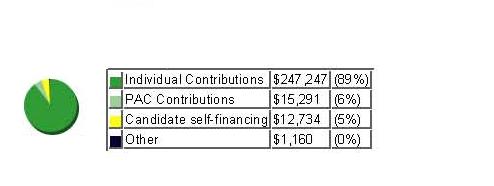
and non-cooperative legislators will find themselves faced with an extremely well-funded primary or general-election opponent. From this springs another half dozen bills to dramatically raise or altogether eliminate restrictions on corporate contributions to campaigns. A perfect storm: corporate funded campaigns to legislators who will carry out a corporate agenda. (Apparently this is worse than being beholden to "immigration reform" shadow organizations,  Or the case of Ms. Wilmer herself, who spent $276,000 in her reelection to the Montana House.  Here's where she got her money:


(So she got $15,000 from PACs. Is she therefore beholden to big moneyed interests herself?)

What all of these bills have in common is that none addresses a problem we have in Montana. They are aimed at carrying out a national agenda. Nowhere does this seem more apparent than in the 6-pack of so-called “schoolchoice” bills. One even gives tax credits to corporations. Now if you ask some Montanans whether they think it would be good to have more “school choices” they might say “yes,” hence the slick designer language. But if you ask most Montanans whether they think we should cut public education funding and give taxpayer dollars to private, mostly religious schools, most would adamantly say “no!” And that’s what each of these bills does in sometimes cleverly designed funding mechanisms that sound like we run public education as a “fees for services” program. If you “choose” take your kid out, you can take your taxes out too. But what about childless couples, single Montana taxpayers, and people whose kids have grown? Why shouldn’t they get a rebate too? (Indeed, why should people without kids in school pay for schools? By reverse logic, why do only those who live in a particular neighborhood have to pay for their road improvements? Shouldn't that be borne by everyone?) 

Because public education is a public good that benefits all of us. (She doesn't say how it benefits all of us. I suppose she's trying to make the case that educated people contribute to society. But don't private schools also educate people?)

Decrying that “one size doesn’t fit all” advocates want to give parents whose kids don’t “fit” a tax rebate they can use at a private school that “fits.” This argument is flawed on many levels. First of all, our teachers and administrators are already innovative and rightly insulted by the false notion that our schools are boot camps grinding out cookie-cutter educated students. (That remains to be seen. Individual schools and/or teachers may indeed be innovative, but we don't know what constitutes innovation, nor do we know that every school or teacher [or even a majority of them] deserve this accolade. Ms. Wilmer is making a sweeping generalization. But worse, she is presuming to know what parents should want, and concludes without justification that public schools meet all those preferences. Clearly they don't or there would be no private schools.) 

Second, Montana already has public charter schools and other innovative programs — 57 of them serving over 1,500 students. (In other words, Ms. Wilmer deems what the state offers to be sufficient and that other choices are not necessary or not legitimate.) 

Third, these public charter schools have certified teachers, are overseen by elected school boards, and guided by statewide standards through the Board of Public Education and Superintendent of Public Instruction. (Washington DC schools have the same characteristics, and they are some of the worst schools in the nation.) 

None of this is true for the proposed private charter schools, which is one reason they are likely still unconstitutional. Third, (Um, fourth, but who is counting?) 

the Montana constitution specifically prohibits taxpayer revenue going to sectarian schools. 

(The Montana Constitution say this in Article 10, Section 6:

The legislature, counties, cities, towns, school districts, and public corporations shall not make any direct or indirect appropriation or payment from any public fund or monies, or any grant of lands or other property for any sectarian purpose or to aid any church, school, academy, seminary, college, university, or other literary or scientific institution, controlled in whole or in part by any church, sect, or denomination.

Do you notice that it says "public funds." Prior to being taxed from people, those funds are "private funds." The potential to tax is not the same as having a pre-existent claim on private funds. That money belongs to the individual taxpayer before it is taken and converted to public use. Therefore, a tax credit, a voucher, or the creation of a class of people to which a certain tax does not apply is not in violation of the Montana Constitution because it isn't "public funds" until government extracts it from the taxpayer.)

Who were the proponents of these bills? Catholic schools, schools offering a “classical Christian education,” and the Christian Montana Family Foundation. Budgetary flimflam aside, tax money that would go to public education retained by taxpayers to pay for private education is tax money going to private education. (She just countered what I wrote above, but leaves it as a bare assertion. Notice the flawed language based on a flawed premise. She starts with the phrase "...tax money that would go to public education..." She's trying to claim that money that belongs to individual taxpayers is subject to a higher claim of ownership by the state. Because the state will take it at some point, it doesn't belong to the taxpayer right now. This means it is public money before it is taken! She continues, "...retained by taxpayers..." You will note that money that hasn't been taxed is simply money retained by the taxpayer. It isn't the taxpayer's money, it is simply retained by the taxpayer. 

She concludes that it is therefore "...tax money going to private education..." Astonishing! Can you imagine, this woman is charged with overseeing the affairs of the state of Montana, but can't even logically approach an issue!)

Montana is not Chicago or D.C. (But those are public schools as well, with all the checks and balances and innovation and certified teachers that we in Montana have. Does this mean she supports private school funding in Chicago or DC?) 

Our dropout rate is 4.1 percent — down from 5.2 percent since Superintendent Juneau initiated her “Graduation Matters” program. Montana students consistently earn top scores in nationally standardized tests of proficiency in math and science. Yes, where there is poverty there is underperformance, and that is true all over the U.S. “Graduation Matters” targets those students too, with great success. And if we pass SB 14 we can join 49 (all) other states that support students staying in school until at least the age of 19, which will certainly further lower our dropout rate. (Yes, Montana schools are generally preform very well. But that still avoids the point. Despite all the benefits of public schools, despite their innovation and high performance results, parents are still choosing to send their children to private schools. They are still exercising choice. They are still rejecting public schools, and Ms. Wilmer doesn't appear to understand why. Or maybe she doesn't care, being beholden herself to special interest funding to the tune of $15,000.) 

You want private schools? Fine. Just don’t ask for taxpayer money to support them.

Rep. Franke Wilmer (D-Bozeman) has served four terms on the House Education committee and is a full professor at Montana State University.