-------------------------
While we share Ms. Prata's concern when these sinning pastors so quickly re-appear in the pulpit, sometimes after very serious sin, we reject the idea that there is no possibility for restoration to the pulpit. We would embrace a broader criteria, since sin of every kind is present in the Church and potentially disqualifying for every person (1Co. 9:27, Col. 2:18), not just pastors. And every man who comes into the Kingdom has a sinful past, even pastors.
It seems Ms. Prata thinks that the sin dividing line is when a man is saved. That is, a grievous sinner, once saved and having grown to maturity of faith, can be qualified to lead, but sin after being saved is not permissible for a leader. So someone like this man, a former porn star who repented, got saved, and is now a pastor, isn't disqualified.
Such a dividing line is completely arbitrary, however.
Ms. Prata lists a single disqualifier, failure to be above reproach. She derives these from 1 Tim. 3:2:
Now the overseer must be above reproach...
In fact, the Bible is replete with examples of leaders who sinned and stumbled, even severely, yet were not disqualified from leadership. David, Samson, Paul, Peter, Noah, Abraham, Jacob... it's a long list. Murders, adulterers, hypocrites, and liars. Yet God used them powerfully. They are historical giants of faith.
So, what does the Bible tell us about restoration, whether it's regarding leadership or not? Ms. Prata never tells us. In fact, she manages to quote only a single Scripture in his whole presentation. It seems important to us to discuss biblical restoration as a concept in an article questioning pastoral restoration.
We find that the church has a responsibility to restore:
Ga. 6:1 Brothers, if someone is caught in a sin, you who are spiritual should restore him gently. But watch yourself, or you also may be tempted.
The word "restore" means exactly fit (adjust) to be in good working order, i.e. adjusted exactly "down" to fully function. So a leader or pastor or any Christian who sins needs to be put back to full function, if at all possible. The person needs to be restored to "good working order." That must always be the goal. No sin should disqualify any truly repentant person to return to their God-given gifts.
Of course, this requires repentance, counseling, examining of subsequent fruit, and continued accountability and evaluation. It is not done quickly or casually. But there is no hint in the Bible that restoration isn't possible or isn't permissible.
We should also mention that the Bible does not teach that pastors lead churches, the elders do (1Pe. 5:1-3). We therefore think that the Church is trying to treat the symptom but not the disease. The problem is that pastors are placed too high. They occupy unbiblical positions at the top of the pyramid. They have too much power, they are subject to too many expectations, and they carry a burden God never put on them. Of course they would tend to fall in such an environment.
Churches are to be led by a group of godly men, not a CEO pastor. This fact underlies the issue of pastoral missteps.
Sadly, that is not the experience of many of the publicly fallen pastors we see. Some who are less well known, of course, follow the prescribed method for repentance and restoration to the pew. But many more who have built their platform publicly, don’t.
They offer some kind of faux repentance or washed-out apology open letter, slide out of the public eye for a while. Then they come back. They either plant a new church, or join an existing church, or start up some para-ministry and begin again as a ‘leader’.
However, a leader who falls is under reproach. He can never regain that necessary trust that’s implicit in a leader-congregant relationship. His sin made him lose the position forever. He is surely forgiven if he repents, but he cannot lead. He has squandered the enormous gift of leading in Jesus’ name.
Why do so many fallen leaders fail at this restoration-to-the-pew process? Why do so many resume leading, as if the scriptures describing what he must do don’t exist?
1 Timothy 3:1-2a says The saying is trustworthy: If anyone aspires to the office of overseer, he desires a noble task. Therefore an overseer must be above reproach…
The word for ‘noble’ in the verse according to Strong’s Greek is “properly, beautiful, but chiefly good (literally or morally), i.e. Valuable or virtuous.”
Again from Strong’s Greek, ‘above reproach’ means simply blameless, unrebukeable.
A leader who has sinned and falls under reproach is no longer able to lead because he is no longer virtuous or blameless.
Why are churches so eager to restore fallen pastors to leadership? Why don’t they walk away?
Tim Challies has some thoughts...
The Master’s University also has some good insights as to how to minister to the fallen leader, “The church should do everything possible to minister to those who have sinned and repented. But that does not include restoring the mantle of leadership to a man who has disqualified himself and forfeited his right to lead. Doing so is unbiblical and lowers the standard God has set” but also an excellent thought on a reason why they keep getting vaulted up to the pulpit again, here in their essay, Forgiving Fallen Pastors.
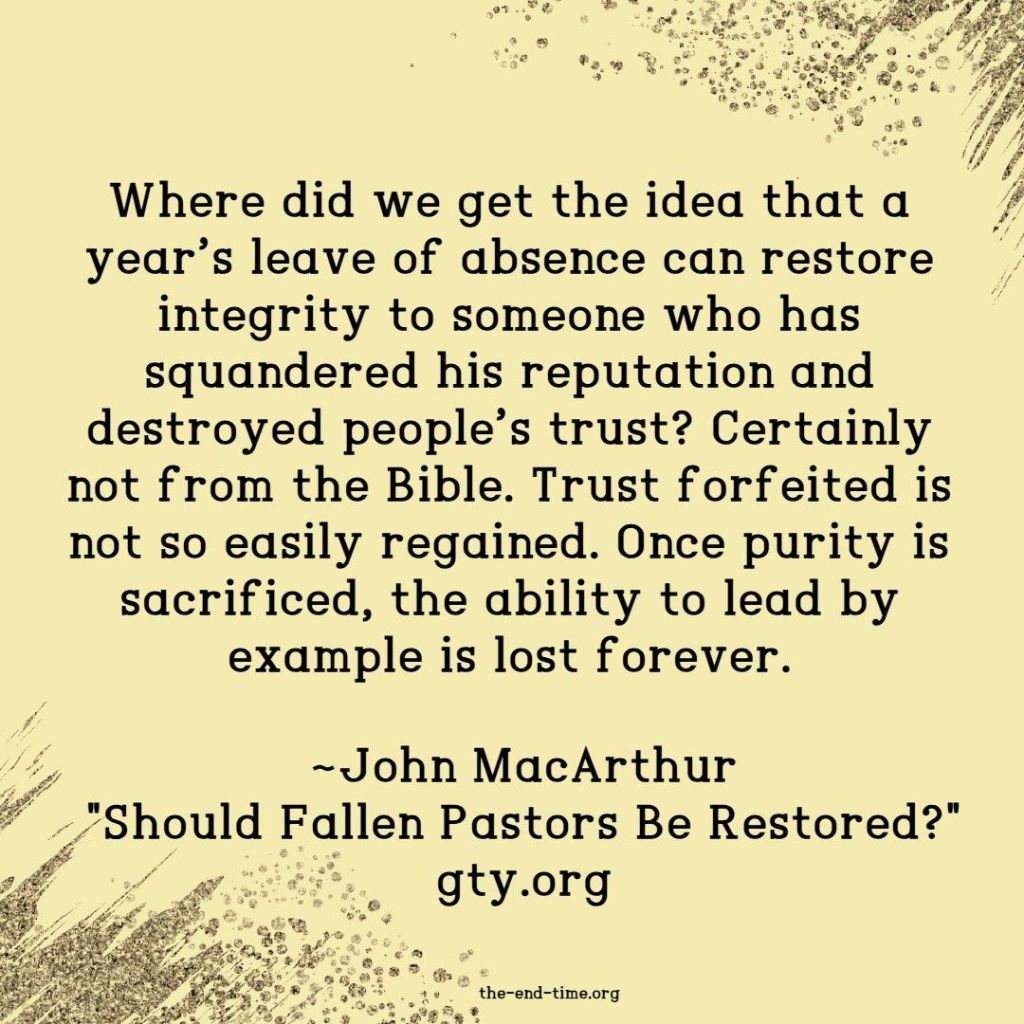
If you see a fallen pastor re-ascending to the pulpit, just know he is in rebellion. If you see a fallen pastor or leader, especially one in your congregation, humbly seek Jesus from the pew, you can and should forgive, offer grace, and love him like the restored brother he is.
Further Resources
Grace To You: Should Fallen Pastors Be Restored?
The Master’s University: Forgiving Fallen Pastors
9Marks: Why Does a Pastor Being “Above Reproach” Matter?
GotQuestions: What does it mean to be above reproach / blameless?

No comments:
Post a Comment