---------------------
The author writes over 2000 words, for the sole purpose of bolstering his tradition. He wants to keep pastors at the top of the leadership pyramid, with everyone else as underlings at the pastor's beckon call.
The author writes over 2000 words, for the sole purpose of bolstering his tradition. He wants to keep pastors at the top of the leadership pyramid, with everyone else as underlings at the pastor's beckon call.
The mistake he makes is to assume that the Bible's overseers, pastors, shepherds, teachers are the same thing as his tradition's overseer/pastor/shepherd/teacher.
They are not.
The author quotes the snippets of three Bible verses, a mere 20 words. That's it. How can one teach the Bible while barely quoting it? We must deem this Bad Bible Teaching.
----------------------
Editor’s Note: Christ Over All examines a different theme each month from a robust biblical and theological perspective. ("Robust?" Self-aggrandizing.)
Editor’s Note: Christ Over All examines a different theme each month from a robust biblical and theological perspective. ("Robust?" Self-aggrandizing.)
And occasionally we come back to themes that we’ve already covered in an “encore” piece. In this article, in light of the renewed discussion on the Truth and Unity Amendment in the Southern Baptist Convention, we re-consider the issue of female pastors as an encore of March 2023: Under Reconstruction: How the Egalitarian Beachball Wrecks the Household of God.
“Every Christian is called to be a minister (Matt. 28:18–20; Acts 1:8; 2 Cor. 5:18), so why bar women from serving in actual pastoral ministry? (He will never discuss women pastors.)
“Every Christian is called to be a minister (Matt. 28:18–20; Acts 1:8; 2 Cor. 5:18), so why bar women from serving in actual pastoral ministry? (He will never discuss women pastors.)
And if a woman is paid by a church to disciple people in the church, then why not call her a shepherd?” (He will never explain this.)
This recent trend to collapse the universal call to make disciples and the particular office of pastor is an example of “concept-creep.”[1] (Irony Alert. "Concept-creep" is exactly what has happened in his church's tradition. The biblical expression of leadership, a governing body of elders, has morphed into a singular CEO pastor at the top of the pyramid. We suspect the Reformation failed to reform the Catholic church's priesthood model, and we have thus inherited their "top dog" leadership style.
This is the author's tradition, but oddly, he will never come out and say that a single pastor leads a church.)
The concept of discipleship creeps into the discussion of the office of pastor. (What is the "office of pastor?" Where do we find it?)
The result of blurring Scripture’s categories (What categories are these, and where do we find them in the Bible?)
is semantic confusion and ecclesiological disorder. (Irony Alert.)
In this article, I will differentiate between the call of every Christian to make disciples and the call of some to serve the church in the office of pastor, and why that makes such a big difference in the debate on female pastors. (Let's hope it's a biblical explanation.)
Make Disciples: The Call of Every Christian
Every Christian is called to make disciples. Jesus’s command in the Great Commission was not limited to ordained men. (What are "ordained men?")
But we are witnessing in our modern moment an impulse to take these legitimate ministries and label them “pastoring.”[2] (If pastoring means care, then yes. But if pastoring means what official pastors get paid to do, then absolutely not.)
Make Disciples: The Call of Every Christian
Every Christian is called to make disciples. Jesus’s command in the Great Commission was not limited to ordained men. (What are "ordained men?")
All believers are called to bear witness to Christ (Acts 1:8), (Perhaps true, but this particular Scripture is Jesus speaking to the disciples prior to His ascent. Let's quote:
Ac. 1:8 But you will receive power when the Holy Spirit comes on you; and you will be my witnesses in Jerusalem, and in all Judea and Samaria, and to the ends of the earth.
Now maybe this charge is given to the whole church, but this Scripture doesn't do it.)
instruct others on how to follow Jesus (Rom. 15:4), Let's quote:
Ro. 15:4 For everything that was written in the past was written to teach us, so that through endurance and the encouragement of the Scriptures we might have hope.
This Scripture has nothing at all to do with "instructing others to follow Jesus.")
encourage the saints (1 Thess. 4:18; 5:11), (***Sigh*** Let's quote:
1Th. 4:18 Therefore encourage each other with these words.
What words? Well, Paul was explaining the return of the Lord on the last day, and how the saints will be caught up in the clouds.
1Th. 5:11 Therefore encourage one another and build each other up, just as in fact you are doing.
Finally a relevant Scripture.)
and serve the body with their gifts (Rom. 12:6–8; (Let's quote:
Ro. 12:6-8 We have different gifts, according to the grace given us. If a man’s gift is prophesying, let him use it in proportion to his faith. 7 If it is serving, let him serve; if it is teaching, let him teach; 8 if it is encouraging, let him encourage; if it is contributing to the needs of others, let him give generously; if it is leadership, let him govern diligently; if it is showing mercy, let him do it cheerfully.
Another relevant Scripture. But no one doubts that the Body has ministry duties to one another using their gifts.)
1 Cor. 12:4–31). Older women are to teach younger women (Titus 2:3). And parents should disciple their children (Deut. 6:4–8; Ps. 78:1–4; Eph. 6:4). The New Testament celebrates this kind of ordinary work of discipleship. (Whoa. Out of left field comes this editorial comment, "ordinary work." Thus the author wants the rank and file to just do "ordinary work," while the clergy, the professionals, well, they're special.)
But we are witnessing in our modern moment an impulse to take these legitimate ministries and label them “pastoring.”[2] (If pastoring means care, then yes. But if pastoring means what official pastors get paid to do, then absolutely not.)
And the problem is compounded in our current age because churches created all sorts of positions within the congregation: administrative leaders, budget oversight personnel, sound technicians, and a host of other positions. These administrative duties are not necessarily wrong, but they start blurring the lines between what a pastor does and what non-pastoral staff and church members do. (Ewww. "Non-pastoral staff." "Church members." This sentence drips with condescension.)
That is partly where the problem begins. (No, this is where the author begins to create a problem.)
That is partly where the problem begins. (No, this is where the author begins to create a problem.)
Shepherd the Flock: The Call of Biblically Qualified Men
Simply stated, the issue is not whether women can disciple, or help care for the needs of a congregation, or organize a Vacation Bible School, or serve in a number of other ways. Complementarians (Undefined term.)
Simply stated, the issue is not whether women can disciple, or help care for the needs of a congregation, or organize a Vacation Bible School, or serve in a number of other ways. Complementarians (Undefined term.)
have long affirmed a plethora of ways women can and should serve the local church (Wayne Grudem affirmed this over thirty years ago in a helpful list[3]). In terms of the Southern Baptist Convention, the Law Amendment[4] from 2023–24 and the currently discussed Truth and Unity Amendment[5] put forward by Al Mohler do not negate ways women can or should minister the word in appropriate contexts (e.g., counseling, encouraging, and normal discipleship). The issue is whether the New Testament allows us to separate the work of pastoring from the office Christ established for pastors. (Will the author cite the verses that describe this, and will he represent them accurately? What exactly is the work of pastoring? Will the author explain anything?)
Increasingly, many evangelicals want to say, “She is not a pastor in office, only in function,” or, “She pastors people without holding the office of elder.” (Will the author accurately define pastoring, i.e., the care of the flock? Biblically speaking, pastors don't lead churches. Pastors aren't even necessarily elders.
Women cannot be elders:
Tit. 1:6 An elder must be blameless, the husband of but one wife, a man whose children believe...
An elder must be a man. Women can teach and pastor because pastors and teachers, biblically speaking, do not lead churches. Pastors aren't elders, though they can be. Teachers aren't elders, though they can be.
Elders lead the church.)
Yet this distinction cannot bear the weight of New Testament evidence. (We hope he will quote the passages.)
The New Testament does not present “pastor,” “elder,” and “overseer” as three unrelated offices or functions. (The New Testament doesn't present any topic as unrelated.)
The New Testament does not present “pastor,” “elder,” and “overseer” as three unrelated offices or functions. (The New Testament doesn't present any topic as unrelated.)
Rather, they are three descriptions of the same office.[6] (This is the traditional view. We will see if the author can demonstrate it biblically. The answer will be no.)
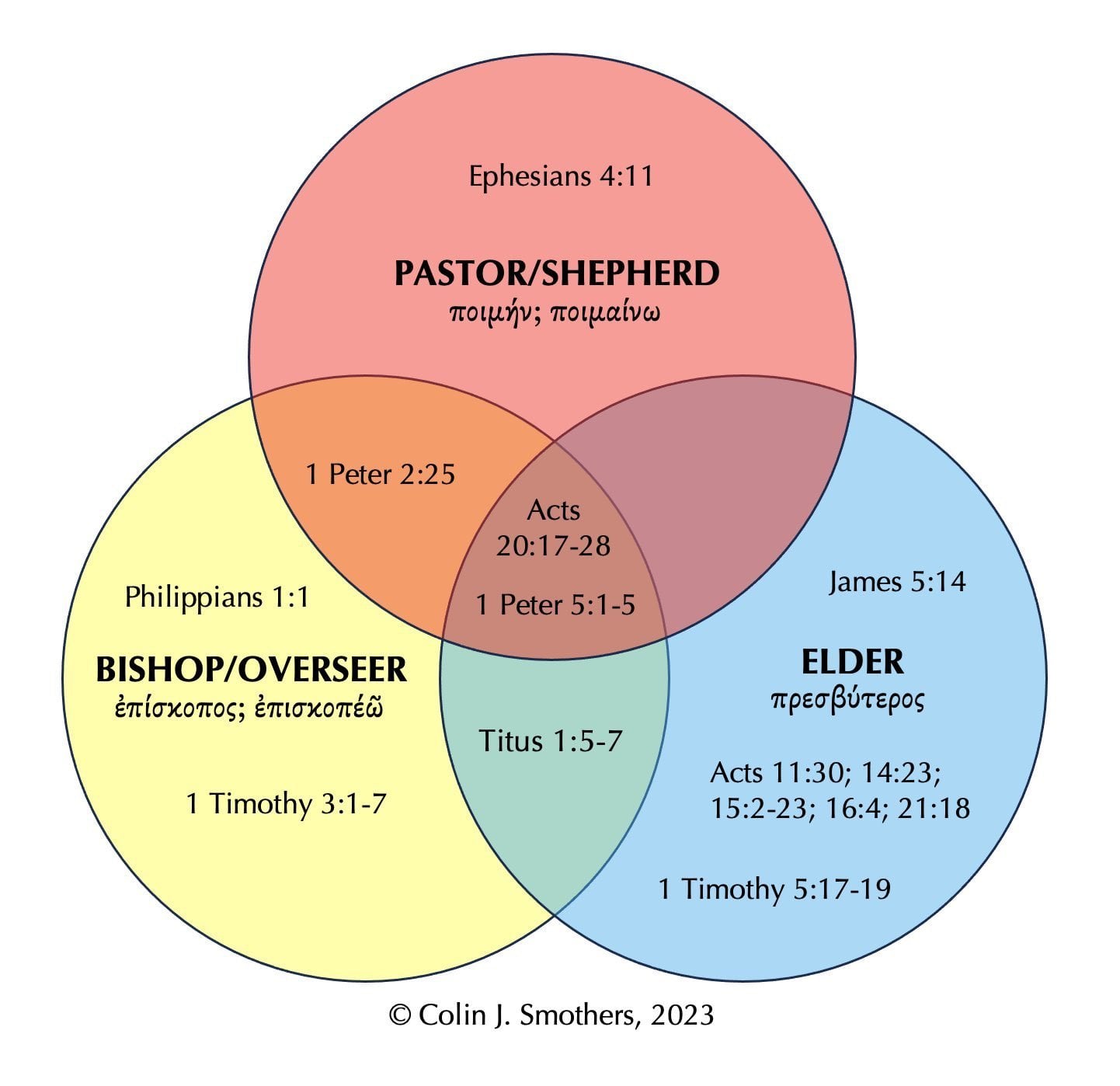
In Acts 20, Paul summons the elders (presbuteros) of Ephesus and tells them that the Holy Spirit has made them overseers (episkopos) to shepherd (poimainō) the flock of God. Elders are called to oversee by pastoring (i.e., shepherding). The same group of men are called elders, overseers, and shepherds within a single passage. (Sir, why is it so hard to quote the Bible? Or at the very least, provide more than the chapter reference. Here it is:
Ac. 20:28 Keep watch over yourselves and all the flock of which the Holy Spirit has made you overseers. Be shepherds of the church of God, which he bought with his own blood.
The author mispresents the Scripture. Paul was speaking to the Ephesian elders, who came to him at his behest. We first notice that Paul did not call them shepherds, he urged these elders to be shepherds, that is, to take care of the flock. He did not say, "be THE shepherds," he said "be shepherds." Nor did Paul call the elders to oversee by pastoring. Nor did Paul create a special category that excludes every other person from these things.
Paul had a lot to say to the Ephesian elders. They must have occupied a very special place in his heart. He told them that he had fully discharged his duty to them [vs. 20, 27], he lived blamelessly [vs. 19, 26, 33], and that he was going to Jerusalem and would never see them again [vs.25, 38]. He also exhorted them to watch over the flock as overseers, and to be shepherds [vs.28] because evil men will try to infiltrate and destroy the church [vs. 29, 30].
Was Paul explaining church government? No. Was he giving a doctrinal treatise? Negative. Paul's purpose was to say his goodbyes, to note that he had lived with them with integrity, and especially to encourage them to do their duty because they were in danger.
But the author wants to bolster his church tradition by inferring what is not implied. These are not "offices," they are duties. In fact, there is no Bible verse that tells us that a man with the title "pastor" is to be the CEO church leader. There is no biblical indication at all that a pastor is even required to be in church leadership.)
Likewise, in Titus 1, Paul tells Titus to “appoint elders (presbuteros) in every town” (Titus 1:5) (Hooray, the author finally supplies his first actual quote of the Bible.)
and that these elders should meet certain qualifications. Then, Paul gives a ground for why Titus should appoint qualified elders: “for an overseer [episkopos], as God’s steward, must be above reproach” (Titus 1:7). So, as you can see, Paul moves seamlessly from “elders” to “overseers,” showing that these terms refer to the same office. ("Elder" is a title. "Overseer" is a duty.)
Peter does the same when he exhorts the elders to “shepherd [i.e., pastor] the flock of God” while exercising oversight (1 Pet. 5:1–2). (Let's quote it:
1Pe. 5:1 To the elders among you, I appeal as a fellow-elder, a witness of Christ’s sufferings and one who also will share in the glory to be revealed: 2 Be shepherds of God’s flock that is under your care, serving as overseers...
Peter was doing the exact same thing to these elders as Paul did to the Ephesian elders: Exhorting them to do and be more than just be elders.
Interestingly, Peter was writing to the churches of Asia Minor, which just happened to include Ephesus. Hmmm...
Here concludes the author's Bible quoting.)
This helpful graphic from Colin Smothers encapsulates the evidence.
Doug Ponder goes even further and shows that the idea of shepherding in the New Testament is either tied to Jesus, the act of literally shepherding sheep, the activity of the apostles or false teachers, or the work of elders. His point in reference to pastor/elders is particularly important:
The role of “pastors [shepherds] and teachers” (Eph. 4:11), which shares a single definite article in the Greek [tous de poimenas kai didaskalous], linking the two terms as either being (a) synonymous or (b) related in some categorical fashion. (Sigh... Why is he so reluctant to quote Scripture? Here it is:
Eph. 4:11-13 It was he who gave some to be apostles, some to be prophets, some to be evangelists, and some to be pastors and teachers...
He is attempting to make the pastor the teacher, again to bolster the traditional church leadership model. But by not quoting the passage he avoids accounting for the obvious problem: If pastor/teachers lead churches, then so do apostles, prophets, and evangelists.
It is irrelevant, therefore, if pastor/teacher is one or two positions. There are three others that need to be accounted for, and the author never mentions them.)
Dan Wallace argues for the latter in his Greek Grammar Beyond the Basics (pg. 284[7]), saying that Paul seems to envision a distinction between pastors who shepherd and pastors who both shepherd and teach with authority (cf. 1 Tim. 5:17).[8] (Sigh... Let's quote:
1Ti. 5:17 The elders who direct the affairs of the church well are worthy of double honor, especially those whose work is preaching and teaching.
First, the verse is about elders, not pastors. And interestingly, it's the Ephesian elders again:
1Ti. 1:3 As I urged you when I went into Macedonia, stay there in Ephesus so that you may command certain men not to teach false doctrines any longer...
Paul, through Timothy, was once again exhorting the Ephesian church elders! They were to do and be more than just elders. Paul acknowledged a distinction between elders who appear to do nothing else [which he does not approve of], elders who govern the church, elders who preach [share the gospel], and elders who teach [instruct the church].
The operative word here is elders. Biblical church leadership is elder focused, not pastor focused.)
Then, of course, there's Phoebe [Romans 16:1-2, Priscilla and Aquila [Acts 18 and Romans 16:3-4]. Then there are several other women in Romans 16 who worked hard in the church. Paul doesn't say what they were doing, but we cannot assume their activities agree with the author's preconceptions.
And what does this Ponder fellow mean by "unordained men?" There is no such thing as an "unordained men." All men are called to qualify as elders.
Further, upon what basis do Ponder and the author make these things exclusive? They assume that because something is mentioned that only the ones it was mentioned for are allowed to do it.)
The New Testament consistently joins the function of shepherding with the office of elder-overseer. (This is true, but that doesn't mean it's exclusive.)
The shepherding task is not detached from the office. (This is false.)
Again, that does not negate the reality that both non-pastoral men and women will care for other believers in significant ways within the local church. (The author suddenly concedes that pastoring happens apart from the pastoral "office.")
It does mean that in the New Testament, shepherding/pastoring is the function of those who hold the office of pastor/elder/overseer. (But, but... The author has not established that pastoring is leading! He hasn't even discussed if pastors ought to be included among the elders. Is he going to explain anything?)
Furthermore, Scripture gives qualifications for this office. In 1 Timothy 3 (Qualifications for overseer, not pastor. Shepherds are not mentioned.)
Furthermore, Scripture gives qualifications for this office. In 1 Timothy 3 (Qualifications for overseer, not pastor. Shepherds are not mentioned.)
and Titus 1, (Qualifications for elder and overseer. The letter to Titus does not mention shepherds.)
Paul does not merely describe gifted Christians generally; he specifies the qualifications for qualified men who hold governing and teaching authority in the church. (Let's quote it:
1Ti. 3:2 Now the overseer must be above reproach, the husband of but one wife, temperate, self-controlled, respectable, hospitable, able to teach...
The author again misrepresents the Scripture. We see that in order to be an overseer one must be a level-headed man who is able to teach. There is no such thing as "teaching authority.")
This is not a statement of male superiority but of divine ordering. And when you live in accord with God’s designs, it leads to human flourishing. Christ loves His church enough to tell her how she is to be governed.
What has happened in many churches is that the therapeutic spirit of modern culture has overtaken biblical precision.[10] We have become uncomfortable with distinguishing roles, perhaps because we fear doing so will diminish the ministry of others. Or, given the impact of woke culture, we are allergic to anything that sniffs of marginalizing a whole category of people (i.e., women). In a desire to be nice to everyone, or give them a “seat at the table,” many have started to create confusion in this egalitarian moment we’ve found ourselves in.
The Beauty of Following God’s Wisdom
Creating distinctions between pastors and non-pastoral roles does not need to diminish anyone. I’ve served in the military for over fifteen years. Roles are distinguished at every level. And yet each person makes a vital contribution to the success of the mission. In a similar way, in the Bible God dignifies every Christian precisely by giving each member a distinct and important role (cf. Rom. 12:6–8; 1 Cor. 12:4–31). (Not roles, spiritual gifts.)
What has happened in many churches is that the therapeutic spirit of modern culture has overtaken biblical precision.[10] We have become uncomfortable with distinguishing roles, perhaps because we fear doing so will diminish the ministry of others. Or, given the impact of woke culture, we are allergic to anything that sniffs of marginalizing a whole category of people (i.e., women). In a desire to be nice to everyone, or give them a “seat at the table,” many have started to create confusion in this egalitarian moment we’ve found ourselves in.
The Beauty of Following God’s Wisdom
Creating distinctions between pastors and non-pastoral roles does not need to diminish anyone. I’ve served in the military for over fifteen years. Roles are distinguished at every level. And yet each person makes a vital contribution to the success of the mission. In a similar way, in the Bible God dignifies every Christian precisely by giving each member a distinct and important role (cf. Rom. 12:6–8; 1 Cor. 12:4–31). (Not roles, spiritual gifts.)
Not every teacher is a pastor. Not every discipler is an elder. Not every gifted counselor is an overseer. And not every overseer/elder/pastor has all the gifting the church needs. (The author is talking about the ministry of the Body one to another, which doesn't come to bear on church leadership.)
When we flatten all ministry into one undifferentiated category, (Who does this?)
When we flatten all ministry into one undifferentiated category, (Who does this?)
we subtly undermine the beauty of Christ’s ordered church. The New Testament envisions a body with diversity, structure, and ordained leadership. (Sir, show us the word "ordained" in the NT.)
Christ gives shepherds to His church not as celebrities or executives, but as under-shepherds who will give an account for souls (Heb. 13:17). (Let's quote:
He. 13:17 Obey your leaders and submit to their authority.
Who are "your leaders?" Pastors? Is the author going to explain anything?)
That office carries authority, responsibility, and qualification.
This is why language matters. (Irony Alert. The author has been rather presumptuous with his use of language.)
A Christian woman who faithfully disciples younger women is doing glorious kingdom work. A seminary professor teaching theology is doing important ministry. A layman leading a Bible study serves the church in Christ-exalting ways. But none of these realities require us to redefine “pastor.” (Define "pastor." With Bible verses, sir.)
The impulse to broaden the term often arises less from exegesis and more from cultural pressure and, in my view, the particularly egalitarian (Undefined term.)
moment that dominates at the present.
But the church does not belong to the spirit of the age. The church belongs to Christ. We do not play fast and loose with the organization of the blood-bought Bride. Instead, we submit to His lordship in all of life, even in how we order the church and speak of the offices within. There is, moreover, something profoundly freeing about embracing biblical categories rather than resisting them. The church flourishes when Christians joyfully embrace the roles God has assigned. He is, after all, wiser than us (Isa. 55:9; Rom. 16:27).
The call, then, is not to diminish discipleship but to preserve the church’s biblical structure (***Sigh*** What is that biblical structure, sir? Are you going to tell us?)
But the church does not belong to the spirit of the age. The church belongs to Christ. We do not play fast and loose with the organization of the blood-bought Bride. Instead, we submit to His lordship in all of life, even in how we order the church and speak of the offices within. There is, moreover, something profoundly freeing about embracing biblical categories rather than resisting them. The church flourishes when Christians joyfully embrace the roles God has assigned. He is, after all, wiser than us (Isa. 55:9; Rom. 16:27).
The call, then, is not to diminish discipleship but to preserve the church’s biblical structure (***Sigh*** What is that biblical structure, sir? Are you going to tell us?)
while unleashing every believer for faithful ministry. All Christians should aim to make disciples, share the good news of Jesus with their lost friends, counsel with wisdom those who need help, teach others to press the gospel into the corners of their lives, and serve those created in God’s image in self-sacrificial ways. But we should also honor the distinctions and specific roles Christ Himself established.
Conclusion
The church does not need less ministry. It needs clearer theology. (Which we do not find here.)
And when theology becomes clear again, the people of God can stop chasing borrowed categories from modern culture and return to the beautiful simplicity of Scripture: every believer—man or woman—is called to make disciples, but not every believer is called to shepherd Christ’s church as a pastor-elder-overseer. (The author hasn't demonstrated this. He's made repeated assertions. But he has never explained the biblical structure of church leadership.)
And to argue otherwise is to call into question the very wisdom of God.
1. As pointed out by Denny Burk (@DennyBurk), “Major concept-creep with the title pastor/shepherd. Many churches are confusing pastoring/shepherding with discipleship. …,” X, May 25, 2026.
2. For example, egalitarian Michael Bird does this in a recent article; see Michael F. Bird, “The Purge of Women as Pastors in the SBC,” Word from the Bird (Substack), May 25, 2026.
1. As pointed out by Denny Burk (@DennyBurk), “Major concept-creep with the title pastor/shepherd. Many churches are confusing pastoring/shepherding with discipleship. …,” X, May 25, 2026.
2. For example, egalitarian Michael Bird does this in a recent article; see Michael F. Bird, “The Purge of Women as Pastors in the SBC,” Word from the Bird (Substack), May 25, 2026.
3. Wayne Grudem, “But What Should Women Do in the Church?” CBMW News 1, no. 2 (Fall 1995): 1, 3–7.
4. “From the Pastor’s Desk: Biblical Complementarity, the Law Amendment, and the Southern Baptist Convention,” CBMW, November 25, 2024.
5. R. Albert Mohler Jr., “Truth & Unity Amendment,” YouTube video, May 18, 2026.
4. “From the Pastor’s Desk: Biblical Complementarity, the Law Amendment, and the Southern Baptist Convention,” CBMW, November 25, 2024.
5. R. Albert Mohler Jr., “Truth & Unity Amendment,” YouTube video, May 18, 2026.
6. See Benjamin L. Merkle, The Elder and Overseer: One Office in the Early Church, Studies in Biblical Literature 57 (New York: Peter Lang, 2003); 40 Questions About Elders and Deacons (Grand Rapids: Kregel Academic, 2008).
7. Daniel B. Wallace, Greek Grammar Beyond the Basics: An Exegetical Syntax of the New Testament (Grand Rapids: Zondervan, 1996), 284.
8. Doug Ponder (@dougponder), “A friend of mine returned from TGC this past week…,” X, April 26, 2025.
8. Doug Ponder (@dougponder), “A friend of mine returned from TGC this past week…,” X, April 26, 2025.
9. Doug Ponder (@dougponder), “A friend of mine returned from TGC this past week…,” X, April 26, 2025.
10. See Philip Rieff, The Triumph of the Therapeutic: Uses of Faith after Freud (New York: Harper & Row, 1966); Carl R. Trueman, The Rise and Triumph of the Modern Self: Cultural Amnesia, Expressive Individualism, and the Road to Sexual Revolution (Wheaton, IL: Crossway, 2020); and David F. Wells, No Place for Truth: Or Whatever Happened to Evangelical Theology? (Eerdmans, 1993) and God in the Wasteland: The Reality of Truth in a World of Fading Dreams (Eerdmans, 1994).

No comments:
Post a Comment